
Why Should I Consider Taking the Forgiven and Set Free Weekend Intensive?

What is it?

The Forgiven and Set Free abortion recovery Bible study is called “intensive” because it takes an 8- 9-week class and condenses it into a long-weekend virtual retreat experience. 

Why should I consider taking the Forgiven and Set Free Weekend Intensive?

If you are a leader or someone considering going into abortion recovery leadership, or you are already volunteering or working with CareNet or another pregnancy center and would like to go deeper in your healing, this may be God’s next blessing for your heart, mind, and spirit. If you have completed some healing on your own, with God, with a mentor, or through a retreat or a weekly class format, but feel there may be more layers to explore that could lighten your load, better equipping you to serve others, then this intensive weekend is for you. Even if you have completed Forgiven and Set Free before, this virtual class offers a safe space to work through the program with your peers. With an intentionally small class size, there is freedom to go deeper with the Holy Spirit to receive all He has for you and to refresh you to continue helping others. 

Who is eligible to attend?

The Forgiven and Set Free Weekend Intensive is designed for women who are either part of one of our leader cohort organizations, such as CareNet, or a pregnancy center, or are in abortion recovery leadership. Exceptions may be made to include participants who are in the advanced stages of healing from a past abortion (s) or who are working toward becoming a future leader. 

What does the schedule look like for the weekend?

The class begins on Thursday evening with a 2-hour introductory session. Friday is a full day with a morning, afternoon, and evening session. There are breaks between each session. Saturday includes only morning and afternoon sessions. Sunday consists of an afternoon and evening session. All sessions are approximately 2 hours long and are completed virtually via Zoom. 

What is the cost for the class and materials?

The class is free. The required book is Forgiven and Set Free by Linda Cochrane. An Even Place will gladly mail you a book. If you’d like to preview the book, here is the information. Forgiven and Set Free Book 2022 edition. 

What have recent participants of the Forgiven and Set Free weekend said about it?

“After going through this class, I feel peaceful, grateful, and healed! I can see a way forward, and feel renewed joy.” Lady H.

“This class felt like a virtual retreat in my own home.” Lady J.

“My confidence in my faith has increased, and my future is brighter.” Lady C.

“I got a deeper understanding of parts of the Bible. I wake up every morning and tell God, “You are in control, not me,” which is helping me tremendously. So when I feel myself getting stressed, I remember He is in control.” Lady T.

“I was very encouraged and hopeful. I gained more understanding and appreciation for the character of God and His faithfulness to heal continually.” Lady C.

How can I learn more or refer a friend or colleague to this class?
Why Am I Still Grieving After a Medically Advised Abortion? (trigger warning)

By Jenny Foster

  • Did you or someone you know have an abortion for medical reasons? 
  • Did medical providers avoid using the word “abortion” or call the termination of your pregnancy therapeutic or “the compassionate choice”?
  • Did your unborn baby receive a devastating prenatal diagnosis?

If you answered yes to any of these or to similar questions, please know that you have my sincere and heartfelt condolences. Losing a pregnancy at any stage, whether a planned or unplanned pregnancy, is exactly that—loss. If no one ever acknowledged that you once carried life and had to say goodbye to your unborn baby, please hear my words written here. 

Whether you’ve gone on to have living children or not, you are a mother. You were chosen by God to be a nurturing vessel for life, no matter how long your unborn baby lived in your womb. Both life and motherhood begin at conception. You were faced with one of the most painful decisions possible in this life, and you survived because you are strong. 

Whether you walked through a medically advised abortion within the last year or thirty years ago, it was likely terrifying to learn that doctors suspected your baby had a life-limiting diagnosis or syndrome deemed to be incompatible with life. Some examples include genetic disorders like Down’s Syndrome and other Trisomy disorders, heart defects, anencephaly, as well as spinal cord and other anatomical abnormalities. Fetal development is incredibly complex, and when all goes as planned, it’s truly a miracle. With our advanced technology, we can detect any number of adverse findings in utero quite early, and there are many things that may give neonatal specialists cause for concern. Perhaps you faced a serious maternal condition that threatened your life. Ectopic pregnancies fall into this type of reproductive loss, but are rarely acknowledged as a loss. 

To the sweet mother or father reading this, please know that this was my story twenty-six years ago. When I imagine someone reading this blog, all I want to do is reach out from behind my laptop monitor and hug you from a place of knowing. After you walked through the trauma of abortion, did you read everything you could find on the topic of reproductive grief and loss, or did you bury the pain so deep that you remain in a place of denial to this day? 

I’ve had the honor of talking with many families over the years who have suffered pregnancy loss for medical reasons, and one of the things I often hear is something I found myself saying in the early years after my abortion. “I didn’t have an abortion. It was a medical diagnosis, and this was the only choice I was given.” Many people told me that my abortion story was “different.” People gently said that I had no reason to seek healing or forgiveness, because I got some kind of “pass.” After all, the circumstances were beyond my control. Then why was I still grieving?

If this is the first thing you’ve read that helps peel back any blinders of denial, I pray it is here today, coming from a sister in Christ who wants to speak this to you with love and compassion. Unless your life was in danger (the case for less than 1% of the population), you did have a choice. I had a choice to say no to a medically advised abortion, but I didn’t take it. Very few things hurt me as deeply as coming to this realization, that although it was neither suggested nor encouraged, I could have carried my wounded baby to term. While only God knows if He would have healed our babies during the balance of our pregnancies, carrying our babies to term might have given our children a chance to be a miracle. If this makes you mad or makes you cry, it’s okay to take time to walk away from this article. Talk to someone, seek counseling, healing resources, and support, and don’t walk through this journey without help, because you are not alone. There are more than 120,000 of us parents who face this impossible decision every year in the United States alone. 

I’ve never written anything as direct as what I am saying here today, but it is out of empathy, experience, and more prayer than I could ever tally. I don’t want to wound your hurting heart, but I want to be honest with you, because honesty is what will help you move out of denial and into a more constructive phase of grieving.

You are still grieving because this is a big grief—a confounded, compounded, and disenfranchised grief. Losing your baby to a poor prenatal prognosis and abortion is grief you’ve earned and deserve to feel. You lost a child, and you deserve to walk through all of the stages of grief that follow: shock and denial, anger, depression, forgiveness, grief and mourning, and acceptance. Why do you still hurt after a medically advised abortion, though much time has passed? Because you were put in an impossible situation, and you are human. Because the medical community lied to you about some things, perhaps even friends or family influenced you to choose termination, hoping it would spare the baby and protect you. This realization is the beginning of healing, and forgiving those involved with your abortion will one day lift a thousand pounds off your chest. 

Our Father in heaven knows what it feels like to surrender His son Jesus to death, death on a cross, because He loved us so much that He died to cover our sins, past present, and future. If you’re reading this you may have wanted your baby, likely loved your baby, and you made the best decision you felt you could at the time, and that decision is in the past. You can’t go back and undo this great loss, but you can talk to God and ask Him to forgive you, which the Bible promises God does in an instant. Asking for forgiveness from our Father in heaven is something you can do today, and I promise you will experience tremendous relief. Ask Jesus to partner with you on this journey and seek out all the healing resources, classes, books, Bible studies, and community you can find. God already knew what choice you would make when you were encouraged to end your pregnancy. He’s a good father, standing by right now, ready to hear your heart and offer comfort to your soul and spirit. Please don’t spend another day living in denial, regret, anger, depression, or shame. Freedom and healing are available today. 

Here at An Even Place, we partner with Jesus to help people just like you find a loving community where hope is possible. Visit us at https://anevenplace.com/.

As an author and abortion recovery leader, Jenny Foster is passionate about meeting hurting hearts with love and compassion. She shares the hope and forgiveness found in Christ with those seeking healing and freedom. You can reach Jenny at jennyfoster@anevenplace.com.  

Do Men Grieve Abortion?

By Jenny Foster

We know the statistics about how common abortion is, with as many as 1 in 4 women worldwide experiencing an abortion in their lifetime. For every one of the 73 million abortions that take place around the world each year, why haven’t we talked about the men?

Why have men been forgotten for so long in abortion recovery?

  • Stereotyped beliefs that few fathers are involved in the abortion decision, that many leave the decision to the woman to make, or that they don’t care are not always the case. Some would argue that men have even been villainized in the abortion narrative. 
  • Because men do not physically carry the pregnancy, they are often relegated to being unimportant in the experience. 
  • It remains illegal for a man in the United States to stop an abortion. He has no constitutional right to do so, even if the child is his.
  • Society expects men to be strong and not openly express grief, leading many to think they’re doing okay and don’t need help.
  • There has been a lack of support and resources, resulting in compounded silence and isolation for fathers of aborted babies. 

Do men grieve abortion?

Absolutely! Men and women grieve just as intensely in any loss—they just grieve differently. 71% of men report adverse effects following an abortion experience, according to a 2023 white paper by Support After Abortion.* Men may experience all of the steps in the grief cycle (shock, denial, anger, depression, grief). Just like abortion-wounded women, men may feel relief, shock, regret, shame, a need to forgive themselves and others, a need to grieve and mourn for their lost child, and the right to honor or memorialize their lost baby. 

How do men grieve differently?

  • Often dismissed or invalidated in the abortion story, it’s common for men to remain silent about what happened.
  • By putting on a brave front or hiding their abortion, things may appear “fine” on the outside. 
  • Men may be less outwardly verbal in expressing their feelings, processing privately, making it less likely for them to confide in safe friends.
  • Many men experience a delayed emotional response to being the father of a baby lost to abortion, not recognizing the trauma as a source of unexplained anger or depression.
  • Due to social norms and pressures, men have been conditioned not to cry publicly, which creates a powerful inhibition of emotions associated with grief and sadness. 
  • Emotional suppression can contribute to frustration and anger, isolation, and self-medication, which can lead to substance abuse.
  • Men tend to express their grief through physical actions, projects, or returning to work to do something about the pain. 
  • Some men experience what feels like a loss of their masculinity, and that they should have been a protector of the mother and child. 

Why is it just as important for men to get healing?

  • Abortion is a loss of fatherhood—a loss of expectations and future dreams for a family. 
  • Men typically go on to become fathers of other living children for whom they want to be functional.
  • Without healing, grief and pain can profoundly impact relationships and families. 
  • Not addressing aftereffects like PTSD, anxiety, depression, and anger can make it difficult for some men to maintain stable employment.
  • Unforgiveness can lead to bitterness, broken relationships, and negative health effects. 
  • If men do not address unresolved grief, the generational cycle of abortion is more easily passed down.

Both men and women grieve reproductive loss deeply, whether it is the loss of a baby to miscarriage, abortion, stillbirth, or the loss of a living child. The death of a child is universally accepted as one of the greatest possible life stressors. Societal expectations have caused many men to take their grief and loss and push it down deeper. Countless men have been sidelined before, during, and after an abortion decision, and are left feeling powerless and silenced, like bystanders watching the demise of their own child.

As a woman, I am sad that men haven’t been given the honor and dignity they deserve to openly grieve the loss of their aborted children—a palpable and cruel example of disenfranchised grief. But I am optimistic and grateful to see a growing number of books, resources, retreats, and healing classes now available for men. 

If you know a man who is hurting from the trauma of a past abortion, please reach out for help and resources. Here’s a great place to start:

https://men.anevenplace.com/

*https://supportafterabortion.com/wp-content/uploads/2022/07/Support-After-Abortion-Mens-Research-White-Paper-VF3.2-1.pdf

As an author and abortion recovery leader, Jenny Foster is passionate about meeting hurting hearts with love and compassion. She shares the hope and forgiveness found in Christ with those seeking healing and freedom. You can reach Jenny at jennyfoster@anevenplace.com.  

How Do I know If I Need Another Healing Group or Bible Study?

By Jenny Foster

  • Are you feeling numb, emotionally stuck, or overwhelmed?
  • Do you experience recurring feelings of shame, anger, grief, or anxiety?
  • Have you been feeling isolated from God or others?
  • Are you looking for deeper healing and connection?
  • Are you carrying a painful secret(s)?
  • Are you experiencing recurring dysfunctional relationships?
  • Have you forgiven people, but unforgiveness keeps coming back?
  • Do you experience triggers related to pregnancy, parenting, relationships, or anniversaries?
  • Do you sense God leading you into further healing work?

If you answered yes to any of these questions, you would likely benefit significantly from additional healing support. There are many benefits to finding a supportive healing group or Bible study, such as: 

    • Having an emotionally safe and confidential space to go deeper in your healing

    • Sharing personal struggles and working through trauma with others who know what you’re going through

    • Gaining biblical knowledge and learning how to apply it to your life

    • Finding accountability within a group to maintain motivation to complete the work

    • Experiencing greater relief of the symptoms of emotional pain

    • Participating in fellowship, encouragement, and spiritual growth with other believers

There are many confidential and compassionate abortion recovery organizations offering retreats and weekly in-person and virtual classes. Check out our website for our offerings as well as additional resources and links to other well-vetted resources. You don’t have to journey alone. 

Blessings of peace and freedom as you explore deeper healing. 

As an author and abortion recovery leader, Jenny Foster is passionate about meeting hurting hearts with love and compassion. She shares the hope and forgiveness found in Christ with those seeking healing and freedom. You can reach Jenny at jennyfoster@anevenplace.com.  

More Resources

Will I See My Baby In Heaven?

By Jenny Foster

Many women and men carry deep questions after abortion or reproductive loss. One question we often hear is, “Will I see my baby in heaven?” While Scripture does not answer every question directly, the Bible offers much hope and comfort that we will see our children in heaven.

Children belong to heaven.

In Matthew 19:14, Jesus said, “Let the little children come to me, and do not hinder them, for the kingdom of heaven belongs to such as these.” You can take comfort in these words straight from the mouth of God that children belong to heaven.

Children are precious to God.

In Matthew 18:3-5, Jesus takes significant time to call a little child to Him, and He highlights how precious children are, saying, “Truly I tell you, unless you change and become like little children, you will never enter the kingdom of heaven. Therefore, whoever takes the lowly position of this child is the greatest in the kingdom of heaven. And whoever welcomes one such child in my name welcomes me. In this same chapter, Jesus goes on to tell the Parable of the Wandering Sheep in verses 10-14, where the shepherd (which also represents Jesus), leaves the ninety-nine to go after the one, likening sheep to people (and to little ones), because all are precious in His sight. “In the same way your Father in heaven is not willing that any of these little ones should perish” (v. 14).

God foreknew your baby and has a plan for every being.

“For you created my inmost being; you knit me together in my mother’s womb. I praise you because I am fearfully and wonderfully made; your works are wonderful. I know that full well. My frame was not hidden from you when I was made in the secret place, when I was woven together in the depths of the earth. Your eyes saw my unformed body; all the days ordained for me were written in your book before one of them came to be.” Psalm 139:13-16

We will join our children in heaven. King David knew that he would go to his baby in heaven.

In 2 Samuel 12:22-23, David, upon learning that his infant son died, said this, “but now that he is dead, why should I go on fasting? Can I bring him back again? I will go to him, but he will not return to me.” David spoke with certainty that, upon his death, he would go to his son in heaven.

Our unique identity will be preserved in heaven where we will be fully known.

“For now we see only a reflection as in a mirror; then we shall see face to face. Now I know in part; then I shall know fully, even as I am fully known.” 1 Corinthians 13:12

God does not make temporary people. We are made in the image of God. Every one of us is unique, planned for, and cherished. In the Garden of Eden before the fall, His plan for mankind was for us to be with Him for eternity. Jesus died to cover all sin for all people, reconciling us back to eternal fellowship with God for those who believe in Him. Children who have not yet had an opportunity to make a free will choice to declare Jesus as their Savior are immediately present in heaven with Jesus upon death. 2 Corinthians 5:8 Our Father preserves the uniqueness of His creation for eternity. He is a God of relationship, and will delight in our reunions with loved ones—one of the most beautiful demonstrations of God’s love and restoration.

If you or someone you know is struggling with grief after abortion loss, please share our resources with them. These are difficult questions, and you do not have to wrestle through this alone.

As an author and abortion recovery leader, Jenny Foster is passionate about meeting hurting hearts with love and compassion. She shares the hope and forgiveness found in Christ with those seeking healing and freedom. You can reach Jenny at jennyfoster@anevenplace.com.

https://anevenplace.com;. 


From Strangers to Brothers: 5 Lives Changed

By Jenny Foster

Imagine five men meeting on Zoom for the first time. They have all joined an online healing group, but don’t know what to expect the first night of class. They are all from different backgrounds, but they have one thing in common, the deep wound of a past abortion where they were the father of the baby. It’s easy to imagine some initial anticipatory anxiety, awkwardness, and uncertainty, but this Zoom meeting starts with prayer. God is invited as the honored guest, and the Holy Spirit’s presence transcends time zones and technology, easing the initial tension. Soon the most extroverted participant shares and encourages the more introverted men to respond, and what happens over the coming weeks of class together becomes a miracle in progress. 

This just happened in a recent abortion healing class for men, here at An Even Place. Two experienced and Godly leaders walked with these men through a weekly Bible study and healing curriculum called Reclaiming Fatherhood by Jill Marquis, Guy Condon, and David Hazard. All the men were at different places in their healing process. One was leading a healing class at a pregnancy center, and another was in the early stages of seeking a relationship with Jesus. The small group dynamic created a safe space for the men to open up, share, and be vulnerable. 

Men are often forgotten in the abortion story. The decision to choose abortion is often left to women, but the loss of fatherhood affects men just as deeply as women. Men are not encouraged to share their grief, which can compound feelings of shame and secrecy. Abortion can impact every aspect of a man’s identity, from his self-worth to his ability to maintain functional intimate relationships. 

One of the group leaders recounted how, over time, the men jumped in to help one another with compassion and grace. He was touched to hear that one of the men bought a Bible for another participant. In the fifth week of the study, one of the guys was really struggling, and the group co-leader spent time talking with him one-on-one, listening with compassion as he shared, “I don’t even know how to pray.” After helping the man discover that what was needed in his life was to surrender and relinquish control, that night he accepted Jesus as his Savior. Soon after, another one of the men in the group talked to his pastor about getting baptized. 

“It’s so powerful to see where we started and where we ended after completing the class,” one leader recounted. During these life-changing evenings together, the men laughed, cried, and even had some fun. They were truly doing life together, and they even started a group chat to keep in touch.

The outcome of men’s groups like these is lives changed. As God’s Word, sound leadership, and forgiveness do their healing work, shame is replaced with forgiveness, and bondage is broken. Another season, another class, another group of men journeying together and finding freedom in the truth and grace of Jesus Christ. From the first week of class to the end, we see strangers become brothers. Brothers who sharpen one another to become healed and whole so they can operate more effectively in the Kingdom as fathers, husbands, sons, and future abortion recovery leaders. What a testimony to the goodness of our God!

If you know a man who walks with abortion wounds, please share this resource with them. 

As an author and abortion recovery leader, Jenny Foster is passionate about meeting hurting hearts with love and compassion. She shares the hope and forgiveness found in Christ with those seeking healing and freedom. You can reach Jenny at jennyfoster@anevenplace.com.

Home

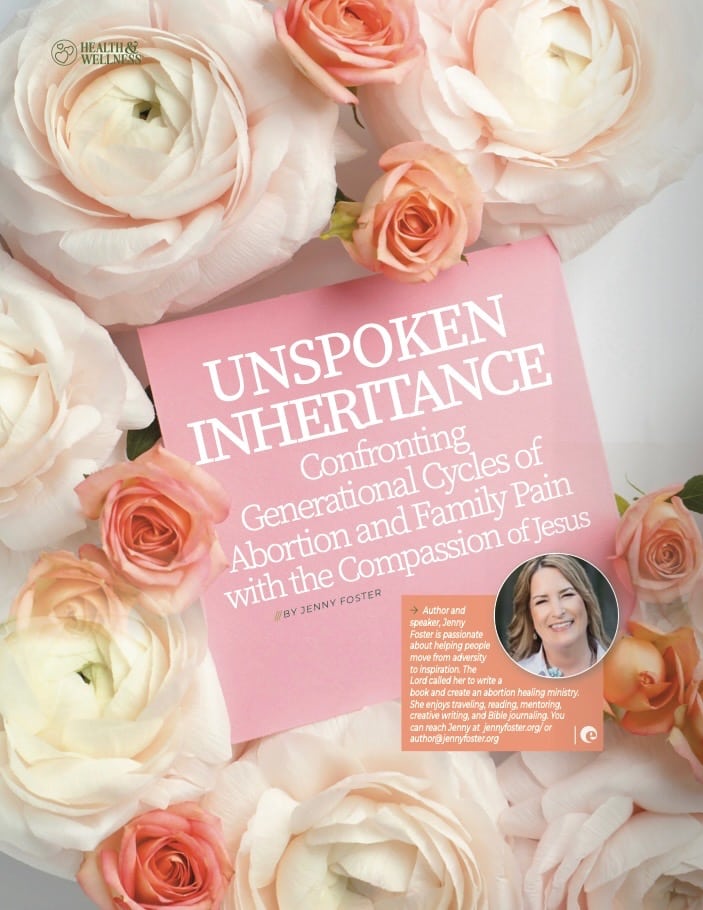
Unspoken Inheritance: Confronting Generational Cycles of Abortion and Family Pain with the Compassion of Jesus

By Jenny Foster

If you do a quick internet search, you’ll see that my story includes the devastation of abortion of a wanted baby within the context of marriage. I write with a heart that will always lead with love and compassion on the topic of abortion, untangled from political opinions. This piece is intended to discuss how abortion, like other painful decisions, can sometimes stem from generational patterns within families that not only impact women but also men, extended families, and future generations. 

In some Christian circles, the term “generational curse” is used, but we will use the term cycle here. Whether or not you or your family can personally relate to an abortion experience, any conversation that compassionately opens the topic of abortion is courageous and can translate into tangible help for hurting hearts around the world.

We are first met with the idea of generational curses (cycles) in the book of Exodus 20:5 (New International Version), where we read, “I, the Lord your God, am a jealous God, punishing the children for the sin of the parents to the third and fourth generation of those who hate me.” We see this repeated in Exodus 34:7. For this discussion, we will not examine the distinction between punishment and consequences, nor are these verses intended as a judgment. 

Generational cycles describe the transmission of destructive behaviors, traumas, mindsets, and patterns from one generation to the next. Within families, these dysfunctions can be passed down both directly and indirectly, often resurfacing in the lives of children who unconsciously replicate what they’ve inherited. Left unaddressed, these patterns contribute to rising rates of addiction, abuse, chronic illness, and other damaging outcomes. They shape not only individual lives but entire communities, reinforcing cycles of pain that can feel inescapable. Some of these behaviors are “caught,” influenced by genetics, while others are “taught,” learned through observation and experience—many are a complex mix of both. Without intervention, these cycles can perpetuate themselves, replicating across generations with quiet persistence.

The internet, social media, talk shows, and podcasts regularly engage with deeply painful issues—substance abuse, alcoholism, sex trafficking, codependency, abusive relationships, eating disorders, abortion, and more. Yet when these same topics are approached through a Christian lens, they are sometimes rejected by audiences as “too much” for the American palate. As a result, many of these urgent conversations remain absent from church spaces, where silence can be misinterpreted as shame.

But silence does not negate the need for healing. Scripture reminds us that our adversary seeks to steal, kill, and destroy—and division is one of his most effective tools. If this conversation feels uncomfortable, consider that a sign of its importance. Most importantly, there is hope for breaking and healing dysfunctional patterns, but we have to go through the hard to get to the healing. When facing an unplanned pregnancy, choosing abortion may pose less stigma and cause less cognitive dissonance for women and men if they’ve been exposed to their mother, sister, aunt, other relatives, or close family friends having an abortion. However, the decision itself and the suffering that likely follows are anything but easy. Abortion is traumatic regardless of circumstances.  

Sydna Masse, author of the book Her Choice to Heal, who has worked with post-abortive women and the abortion-vulnerable for over 30 years, shares that she’s seen clear trends in abortion behavior across generations. As an abortion recovery leader myself, I have listened to and read many stories of women who recount their mother or sister’s abortion or, more miraculously, how they were almost aborted themselves. 

Like every generational cycle, the cycle of abortion can be broken. While there are countless reputable counseling resources, books, programs, classes, and retreats designed to help in the healing of substance abuse, sexual abuse, eating disorders, codependency, abortion, and so many other areas of suffering, complete and total healing is found in accepting Jesus Christ as our Savior, who offers free, unmerited grace and eternal forgiveness. Unlike other paths to healing, which are inherently good, walking the path to healing with Jesus is not just good; it is restorative and redemptive. That’s our God, and that’s my King!

When your identity is in Christ, you no longer need to identify with dysfunctional family patterns. You can choose to break free, heal, and become a change agent and ambassador of Christ for future generations. If you are carrying the weight of generational sin or the pain of abuse, abortion, or any of the struggles discussed here, know that you don’t have to face them alone. Reach out for support. In Jesus, there is a starting point for healing and a source of hope for every wounded heart.

As an author and abortion recovery leader, Jenny Foster is passionate about meeting hurting hearts with love and compassion. She shares the hope and forgiveness found in Christ with those seeking healing and freedom. You can reach Jenny at jennyfoster@anevenplace.com. 

Written by Jenny Foster, as published in the Summer edition of The Sisterhood Magazine available at https://www.thesisterhoodmag.com/.

Leader’s Perspective – What Does Healing After Abortion Really Look Like?

By Jenny Foster

Posted with permission from Audrey*

I had the honor of leading a Forgiven and Set Free abortion healing class recently. From the first week, Audrey showed up on time with her homework completed, ready to connect and engage with the other women in the group. She described herself as mid-way through her healing journey and was articulate and open about her self-awareness and feelings. It was clear that she already understood the stages of grief and the steps necessary to move forward in biblically-based healing. 

Audrey’s story was one of becoming pregnant and choosing abortion twice with the same abusive man. Through her healing journey, she realized how normalized abortion had been around her. She used staying busy to press down the emotions and to cope. For years, she dealt with anxiety, shame, grief, and sadness, and she struggled to accept forgiveness from God. 

She shared that letting go of anger and resentment of others and of herself was one of the hardest parts of the class for her. She went on to make deep connections during our group study of forgiveness, and she was the first to push herself to forgive all of those directly or indirectly involved with her abortions. Her progression through the class was inspiring to the other participants, and her vulnerability helped others feel more comfortable.

Audrey has a beautiful smile that lights up her face and makes her eyes sparkle, but we didn’t see much of her smile in the early weeks of class. It was priceless to see her facial expressions become lighter as the study progressed. By the last two weeks of our time together, her face was radiant with that smile, as if a weight had been lifted off her shoulders and heart. 

We asked Audrey how she’s feeling now after completing Forgiven and Set Free, and she describes herself as healed, joyful, and feeling that her confidence in her faith has increased. “I can see a way forward, and I feel a sense of peace now.” 

It is truly an honor to walk alongside women as they partner with Jesus to receive His free gift of forgiveness.

As an author and abortion recovery leader, Jenny Foster is passionate about meeting hurting hearts with love and compassion. She shares the hope and forgiveness found in Christ with those seeking healing and freedom. You can reach Jenny at jennyfoster@anevenplace.com. 

*Name has been changed for confidentiality

April is Abortion Recovery Awareness Month: Did You Know Online Abortion Healing Is A Thing?

By Jenny Foster

Did you click on this blog post because you or someone you know may have been affected by abortion? If so, you are in a safe and informed place to find compassion, help, resources, or to learn more about the impact abortion has on women, men, fathers, grandparents, siblings, extended family, friends, and future generations.

We are grateful you’ve found your way to our website at An Even Place. Here you can learn about online abortion recovery groups for women and men. We hold monthly drop-in support groups, and we also offer classes for healing in the areas of sexual brokenness and abuse. Visit our online Healing Corner portal to work through a well-vetted curriculum at your own pace.

Abortion affects over 1.1 million Americans each year, and more are unreported. Healing from abortion is vitally needed, irrespective of one’s political position. Once an abortion has happened, it’s in the past, leaving countless women and families needing a place to turn for help. Common symptoms following an abortion or abortions include depression, anxiety, PTSD, guilt, secrecy and shame, disenfranchised grief, and, for some, medical complications.

Here are some additional resources on Abortion Recovery Awareness. There are many excellent organizations offering both Christian and secular healing programs in the form of weekly classes, weekend retreats, and virtual groups such as Deeper Still, Rachel’s Vineyard, Surrendering the Secret, local pregnancy centers, the H3 Helpline

https://abortionrecoveryawareness.org

https://www.heartbeatinternational.org/april-is-abortion-recovery-awareness-month

If you or anyone you know needs confidential help, we are here. Simply complete our short INTEREST FORM at https://anevenplace.com/, or you can find a link to the form here.

Please consider sharing these resources via social media or among your friends, peers, or colleagues. If you take a small step in courage to open up a conversation on the topic, you’ll be surprised how many people can relate or have walked through the journey of abortion, both male and female. One of the best things you can do is to share about the need for abortion recovery within your church or faith community. Please be a voice in the silence to help others find their way into the light of hope and healing.

As an author and abortion recovery leader, Jenny Foster is passionate about meeting hurting hearts with love and compassion. She shares the hope and forgiveness found in Christ with those seeking healing and freedom. You can reach Jenny at jennyfoster@anevenplace.com.  


1,000 Words for Grief: How Many Ways Are There To Grieve?

By Jenny Foster

Grief. We all experience it at some point in our lives, and it’s truly universal. Grief most often refers to deep sorrow, especially related to someone’s death. When we consider the many languages across the world, there are thousands of words to describe grief. 

In our fast-paced world, there is an unspoken pressure to “bounce back” from grief. Ignoring or suppressing these feelings doesn’t make them go away; it only forces them to manifest elsewhere. Incomplete resolution of grief can show up in physical symptoms such as chronic fatigue, stomach issues, muscle tension, and even a weakened immune system. There are also well-documented mental health risks, such as clinical depression, anxiety, or prolonged grief disorder. 

To heal, we must accept that grief, in all its messy and unpredictable forms, is not a problem to be solved but a process to be lived. While the experience of grief is universally shared, it’s fascinating to explore how grief is handled differently across cultures. 

Individual vs. Collective Mourning

In Western cultures, grief is often a private, individual journey. In both eastern and indigenous cultures, grief is felt and supported by the entire community. 

Emotional Expression

Some cultures encourage visible mourning in the form of loud, public displays of grief as a form of catharsis and respect. African and Middle Eastern traditions often involve wailing or lamenting, whereas other cultures, such as the U.S., Finland, and Taiwan, discourage visible crying and encourage private prayer.

Duration

Cultural norms define how long a person is “allowed” to grieve before it’s considered problematic. Judaism features structured stages of grieving, including Shiva for seven days followed by Shloshim for thirty days. In traditional Chinese culture, mourning can last 100 days or even up to three years for a parent or a firstborn son, during which social activities are limited. In Egypt, it is considered normal to grieve for seven years, whereas in the U.S., intense grief exceeding twelve months may be labeled as “prolonged grief disorder.”

Symbolic Colors

Black traditionally signifies sorrow in many Western and some African traditions. White symbolizes purity and is the color of mourning in many Asian cultures, including China and India. 

Relationship with the Deceased

Many cultures emphasize an ongoing relationship with the dead rather than “detaching,” such as Mexico, which celebrates The Day of the Dead (Día de los Muertos), The Obon Festival in Japan, and Toraja in Indonesia, which provides for keeping the deceased in the family home for months or years before a grand funeral is held. As Christians, we are discouraged from talking to or engaging in an ongoing relationship with the dead. Deuteronomy 18:10-11, Leviticus 10:27, and Leviticus 20:6 are clear. We are not to engage in activities as any “medium” between God and the dead, and this should be taken seriously by those of us who desire to follow Biblical directives. In the United States, memorializing the deceased is common in the form of a headstone at a cemetery, a memorial service, a celebration of life, or a foundation created in the loved one’s name.

If you or someone you love has been impacted by the loss of an unborn child through abortion, miscarriage, or stillbirth, grief is just as palpable as it is for those who have lost someone who has been born and lived. These mourners have the same need to grieve, but are often disenfranchised when society doesn’t consider their loss “worthy” of grief. 

Grief doesn’t follow a neat linear path; it comes in waves that may recur for years. Acceptance, typically the final stage of grief, doesn’t mean you are “okay” with what happened, but it means acknowledging the reality of the situation so you can stop fighting it and start living within it. Over time, you don’t “get over” grief. Instead, you integrate it into who you are, creating a “new normal” where joy and sorrow can coexist.

If you or someone you know is stuck in their grief and is not progressing, please consider referring them to a licensed counselor or contacting the National Mental Health Hotline at 866-903-3787. Warmline.org also provides phone lines across the country that can provide compassionate support. 

For help with healing and recovery following an abortion, please contact us at An Even Place

As an author and abortion recovery leader, Jenny Foster is passionate about meeting hurting hearts with love and compassion. She shares the hope and forgiveness found in Christ with those seeking healing and freedom. You can reach Jenny at jennyfoster@anevenplace.com..